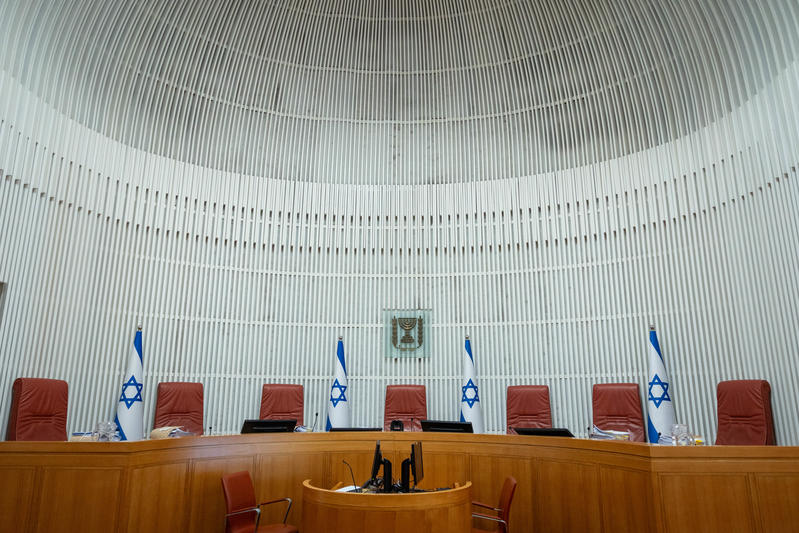
Supreme Court Justice Yael Wilner rejected a request for leave to appeal in a turbulent inheritance case between siblings, ruling that even a will signed before a notary is not immune from annulment.
And here's the thing: An inheritance dispute arose between brothers from a settlement in the south. The late father, who ran a family farm for years, signed a will at the end of 2014 in which he bequeathed all of his property, including the farm, to just one son - the son who had cared for him over the years - while completely disinheriting his other children from the inheritance.
 Want more news, videos and stories? Join the Haredim 10 WhatsApp channel >>
A few months later, in early 2015, the father was diagnosed with advanced Alzheimer's disease. In a dependency assessment by the National Insurance Institute, he was described as not recognizing his surroundings, having difficulty finding his way around, and requiring almost complete supervision.
After the father's death in 2019, the heir filed a petition to have his will executed. The disinherited brothers filed an objection with the Tel Aviv Family Court, claiming that their father was demented when he signed his will.
According to them, their late father began showing signs of cognitive decline as early as 2013, and during 2014 he experienced episodes of confusion and disorientation. Despite this, in December of that year, the father signed the will before a notary, who appeared to understand its meaning. This impression was not based on any medical opinion.
In light of the brothers' objection, the Family Court appointed a psychiatric expert on its behalf to examine, based on the deceased father's medical records, whether he suffered from dementia at the time of signing the will.
The expert determined that, given the slow rate of progression of Alzheimer's disease, it was unlikely that the father was fully competent at the time of signing the will, as after only three months, he had reached a very advanced stage of the disease. Therefore, the expert estimated, with a probability of 55%–65%, that the deceased father was already suffering from Alzheimer's disease at the time of signing the will.
Despite the expert's determination, the Family Court preferred the testimonies of the deceased's neighbors and members of the community, who testified that the deceased was lucid when he signed the will.
The brothers, dissatisfied with the decision, turned to attorney Avi Gefen, who filed an appeal on their behalf to the District Court. As part of the appeal, Attorney Gefen presented documents that the heir had submitted to the National Insurance Institute, in order to have his father recognized as a dependent on grounds of dementia.
The son submitted the documents to the National Insurance Institute near the time the father signed the will. In them, he described his father as completely demented, as someone who did not recognize his surroundings and needed almost full assistance with daily activities. On the other hand, before the Family Court, the same son claimed that his father was completely lucid when the will was signed.
The district court ruled that two contradictory representations cannot be made to two different state authorities, emphasizing that "the court is not a program as you request.".
The majority of judges preferred the medical documents drawn up in real time over later testimony, and ruled that Alzheimer's disease develops gradually, and therefore it is unlikely that the father was competent at the time of signing.
Accordingly, the will was revoked and it was determined that the estate would be divided among all heirs according to law.
The heir did not give up, and through his attorney submitted a request for leave to appeal to the Supreme Court, but as stated, it was rejected about two weeks ago.
Just these days, the heir's attorney submitted another request to the Supreme Court to reconsider the decision. The request was examined by Judge Wilner, who also rejected it, after noting that the reasons mentioned in it had already been raised in the original request for leave to appeal.
In her decision, Judge Wilner ruled that the mere fact that the District Court overturned the Family Court's decision does not allow for an automatic third-instance appeal to the Supreme Court, and this permission will only be granted in exceptional cases that raise a broad question of principle, or when there is a concern about a miscarriage of justice.
According to her, the case in question is rooted in the individual circumstances of a family dispute and does not warrant further hearing. Judge Wilner further ruled that even when the appellate court reaches a different conclusion than the trial court, and even when its decision is not unanimous, this does not in itself establish a right to further appeal.
Judge Wilner reiterated the rule that an appellate court's intervention in factual findings is limited, but possible in appropriate cases. She referred to the fact that the will that was annulled was a notarial will. A notarial will is signed in the presence of a notary, who is responsible for determining the testator's competency.
According to the judge, the notary's determination should be given real weight, but this does not prevent the court from retrospectively examining the testator's cognitive state and deciding to annul it.
According to attorney Avi Gefen, the Supreme Court was right in its decision. "This is an inheritance dispute in which it was proven beyond a reasonable doubt that the father was demented, if only for the reason that Alzheimer's disease does not develop very quickly.".
According to him, the heir's opposite version, which was submitted to the National Insurance Institute, in which he claimed that his father was completely demented, only reinforces this conclusion. According to Attorney Geffen, Judge Wilner's ruling is extremely important because it will make it easier in the future to challenge notarial wills if new, material facts come to light after they were signed - which cast a heavy shadow on the testator's competence.