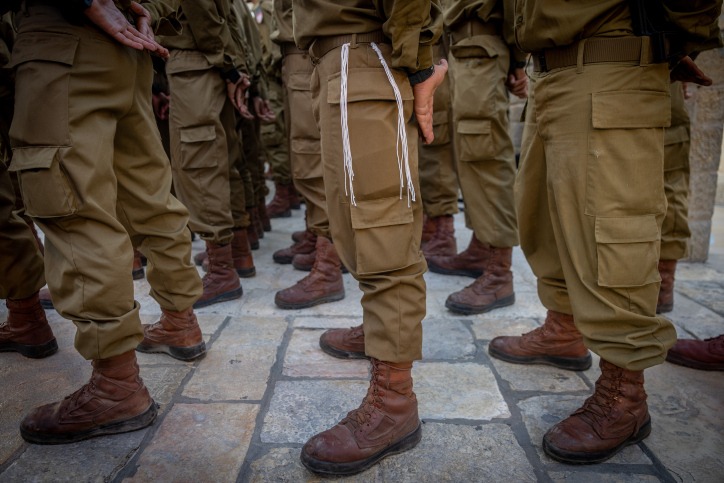
IDF recruitment data by cities and localities in Israel indicate long-term trends: an increase in the recruitment rate of religious women and a decrease in the rate of men enlisting in concentrations of the ultra-Orthodox public.
The data, published on Channel 12, refers to the conscription rate of those born in 2003. According to the army, these are the most complete and up-to-date data, because the calculation of the conscription rate is "closed" only 3 years after graduating from high school, in order to also include recruits who went to preparatory courses, years of service, yeshivahs, and the like. Also, the data refers only to those who receive a conscription order according to the law, and therefore Muslim Arabs, for example, are not counted in it - but Haredim are. If so, what do you see in the data - and where is your locality?
Recruitment data for the ten largest cities in Israel shows that the leaders in both male and female recruitment are Rishon LeZion and Holon. In third place is Beer Sheva for men, and Tel Aviv for women.
At the bottom, in both categories - Jerusalem and Bnei Brak. In the capital of Israel, only 381% of men enlist and less than a quarter of women. In Bnei Brak - 121% of men enlist and only 21% of women.
The recruitment rate in Tel Aviv - which stands at 701% of men and women - is not perfect, but it is a far cry from the low recruitment rate in ultra-Orthodox cities, which stands at only about 101%.
Despite the boasting of military officials that there has been an increase in ultra-Orthodox recruitment, according to the data, the recruitment rate among men in concentrations of the ultra-Orthodox public has decreased significantly in recent years.
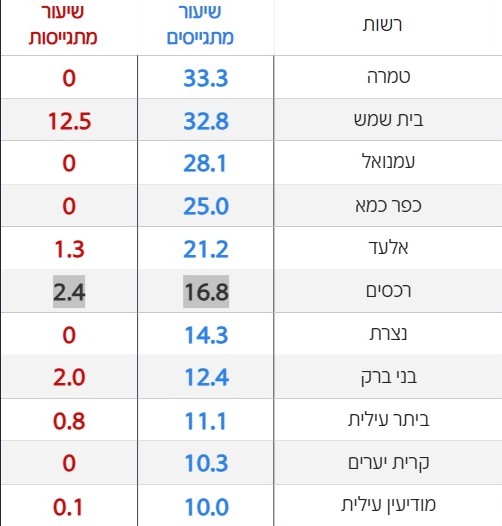
The ultra-Orthodox cities at the bottom. Photo: Screen, Channel 12.
Those born in 1997 in ultra-Orthodox communities enlisted at a rate of 161%-171%, but in the same communities six years later, the enlistment rate dropped to 101%-121% of the population.
On the other hand, there is an increase in the rate of recruitment into the IDF among women in communities identified with religious Zionism.
According to the data, in Emmanuel
 Join the Haredim 10 Facebook page >>
 Join the X page of Haredim 10 >>
 Want more news, videos and stories? Join the Haredim 10 WhatsApp channel >>