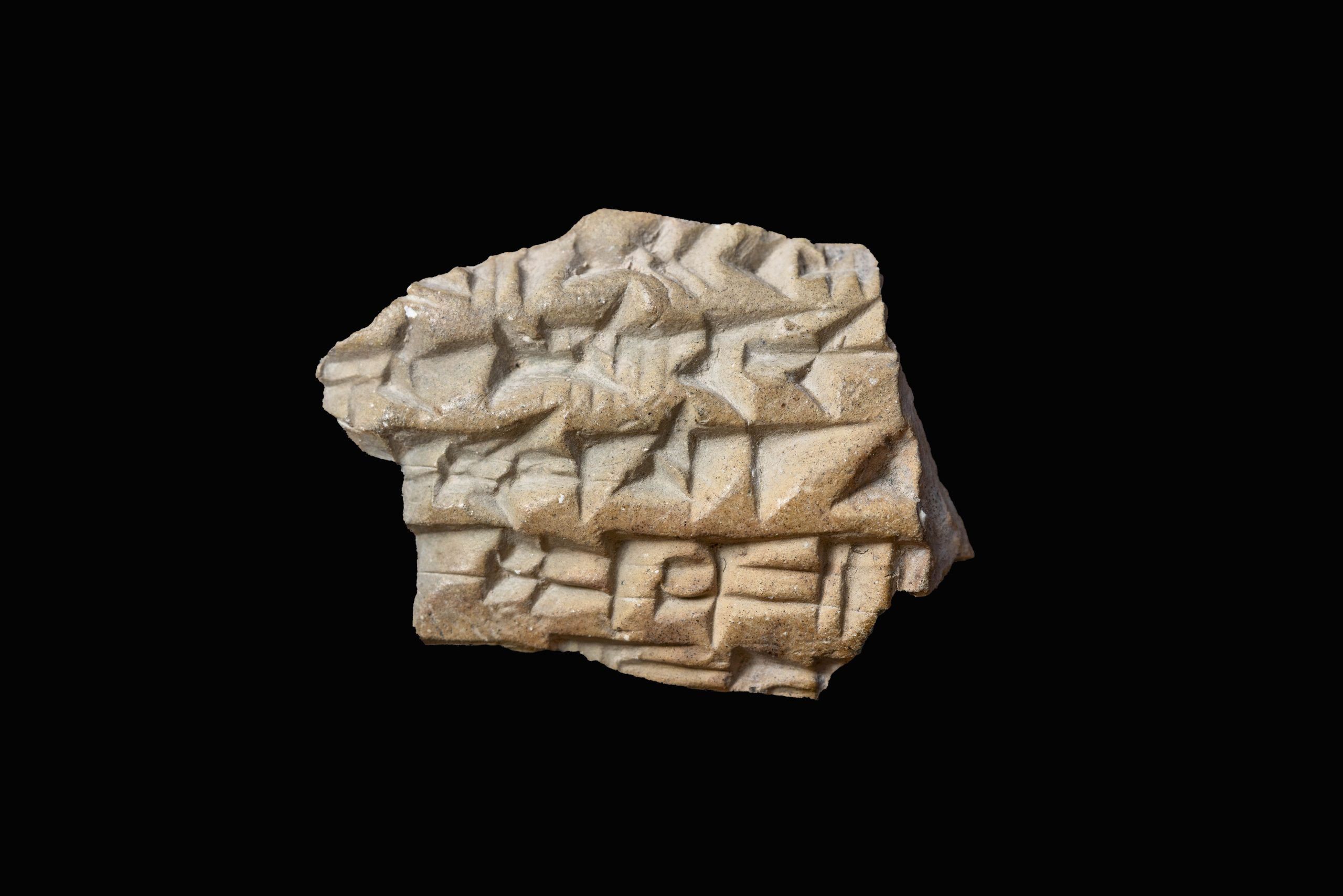
A tiny, extremely rare pottery shard, bearing a cuneiform inscription in the Akkadian language from about 2,700 years ago, was discovered in an archaeological excavation near the Western Wall, north of the City of David.
This is an extraordinary find and the first of its kind. It is the only Assyrian inscription from the First Temple period - the 8th to 7th centuries BCE - found in the city.
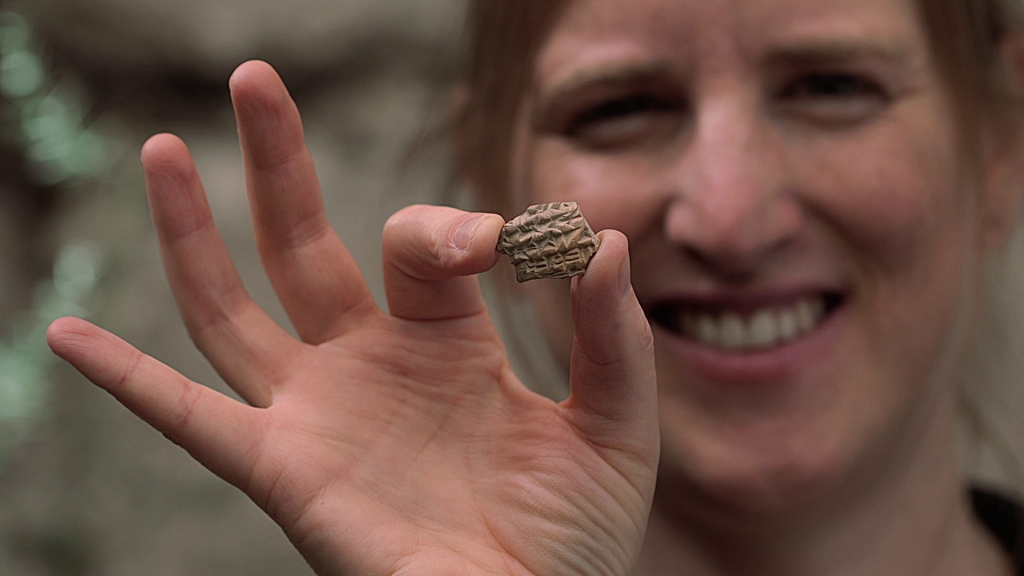
The tiny fragment, about 2.5 cm in size, was discovered as part of a wet screening conducted at the 'Archaeological Experience' in Emek Tzurim National Park – a joint project of the Israel Nature and Parks Authority and the City of David Association.
The discovery of the find in an organized archaeological excavation was accompanied by great excitement.
Moriah Cohen, who works at the 'Archaeological Experience' in Emek Tzurim, described the moments of the discovery: "I was sifting through the dirt and suddenly I noticed pottery with a strange decoration. I looked at it closely, and it looked like cuneiform to me, but it seemed so illogical because even though a lot of fascinating finds have already been discovered here, we've never found anything like this. I examined the pottery again and after I realized that it wasn't decoration but really cuneiform - I screamed with excitement. Everyone gathered around me and I called Ayla - the excavation director, who was very excited by the find.
""The thought that after 2,700 years, I am the first person to actually touch this pottery with my hands - it's a very exciting thought. It's a once-in-a-lifetime find.".
The find was discovered in dirt that had been swept to the edge of the central drainage canal from the Second Temple period, likely from the collapse of an earlier structure from the First Temple period that was discovered in an area where the drainage canal was not preserved.
The site, located at the foot of the eastern slope of Jerusalem's western hill, is one of the closest points to the temple complex that has been excavated so far, a fact that gives the find great importance for understanding the urban and political development of the period.
Dr. Ayala Zilberstein, director of the excavation on behalf of the Israel Antiquities Authority: "The inscription provides direct evidence of official correspondence between the Assyrian Empire and the Kingdom of Judah. The discovery strengthens our understanding of the depth of the Assyrian foothold in Jerusalem, and the extent of its influence on the conduct of the city. In addition, it expands knowledge about the status of the new neighborhood that developed at that time on the slopes of the hill west of the Temple. It appears that this area served as a focus for the activities of ministers and high-ranking figures.".
Dr. Peter Silberg and Dr. Philip Wokosbowitz believe that the fragment of the inscription was part of a royal stamp - a seal impression intended to sign a letter or official dispatch on behalf of the Assyrian royal court. "Stamps of this type bore an impression that was sometimes accompanied by a short inscription, which explained the contents of the dispatch or its destination in Assyrian cuneiform, and they differ in size and shape from the local stamps known in Judea," the Assyrian scholars explain.
Analysis of the inscription fragment and its content reinforces the hypothesis that the signed document deals with a delay in paying a tax or other obligation. The inscription specifies a due date - the first of the month of Av, and explicitly mentions a chariot officer ("one who holds the reins" in the Assyrian language). This title indicates a high-ranking personality, responsible for conveying official messages on behalf of the royal house, and such a figure is well known from the archives of the Assyrian administration.
Although the inscription fragment does not include an explicit mention of the name of the king of Judah to whom the shipment was intended, the chronological context and the partial text allow us to assume that it was sent to the court of one of the kings of Judah, Hezekiah, Manasseh, or Josiah at the beginning of his reign, during which time Judah was a protectorate of Assyria.
Items of this type served as a means of communication between the envoys of the Assyrian government and the ministers of Judah, conveying official instructions and tax demands.
""Although we are unable to determine whether this is a technical delay or a proactive step with political significance, the mere existence of this type of official appeal may indicate a certain point of friction between Judah and the imperial government," the researchers say.
One of the research directions being examined is that the royal seal impression was sent to Judah during the reign of Sennacherib, king of Assyria, since the characteristics of the inscription, and its dating to the reign of this king or one of his descendants, may perhaps echo a story of a tax revolt, such as the biblical description of Hezekiah's revolt, which is narrated in 2 Kings (18:7): "And he rebelled against the king of Assyria, and did not serve him.".
A petrographic examination of the bulla indicated that it was not produced in Jerusalem, but was sent here from a long distance, most likely from one of the administrative centers of Assyria such as Nineveh, Ashur, or Nimrod.
Dr. Anat Cohen-Weinberger of the Israel Antiquities Authority: "Examination of the composition of the inscription fragment clearly showed that the material from which it was made is completely different from the local raw materials used to produce pottery, bullae, and clay certificates in Jerusalem and the southern Levant. In addition, the mineral composition of the bulla generally matches the geology of the Tigris Basin region, where the central cities of the Assyrian kingdom were located, such as Nineveh, Ashur, or Nimrod.".
""A chemical analysis of the bulla's composition is currently being conducted in collaboration with Dr. Yehudit Harleben from the Geological Survey, with the aim of precisely determining the source of production.""
The researchers add: "This is a small fragment of great significance. The find opens a window into understanding the political and administrative ties between Judah and Assyria, and is the first evidence of its kind of the official, and perhaps even tense, communication that took place between Jerusalem and the most powerful power in the period we are discussing.".
The inscription will be presented to the public for the first time tomorrow (Thursday) at the conference "Innovations in the Archaeology of Jerusalem and its Surroundings" by the Israel Antiquities Authority, the Hebrew University of Jerusalem, and Tel Aviv University, at the Jay and Ginny Schottenstein National Center for Archaeology in Jerusalem.
 Join the Haredim 10 Facebook page >>
 Join the X page of Haredim 10 >>
 Want more news, videos and stories? Join the Haredim 10 WhatsApp channel >>