Strategic consultant Haim Kliger, 50, a resident of the city of Beitar Illit, author of the best-selling book "How to Sell a Popsicle to the Haredim" on marketing and advertising for the Haredi sector, has been involved in advertising, communications, strategy, public relations and marketing for 30 years. During all these years, he was responsible for marketing, advertising and strategic moves in the Haredi community and beyond. Among other things, he was responsible for the marketing moves of the third daily in the Haredi community, "Hamveser", from the day it began publication 13 years ago, for Aliza Bloch's victory in the race for mayor of Beit Shemesh, for Israel Porush's two victories in the Haredi city of Elad - and for dozens of other moves, some well-known and some not... In recent months, he launched the podcast "Ta Shema" - on marketing and advertising for the Haredi sector.
Who is the 'next big thing' in Haredi marketing?
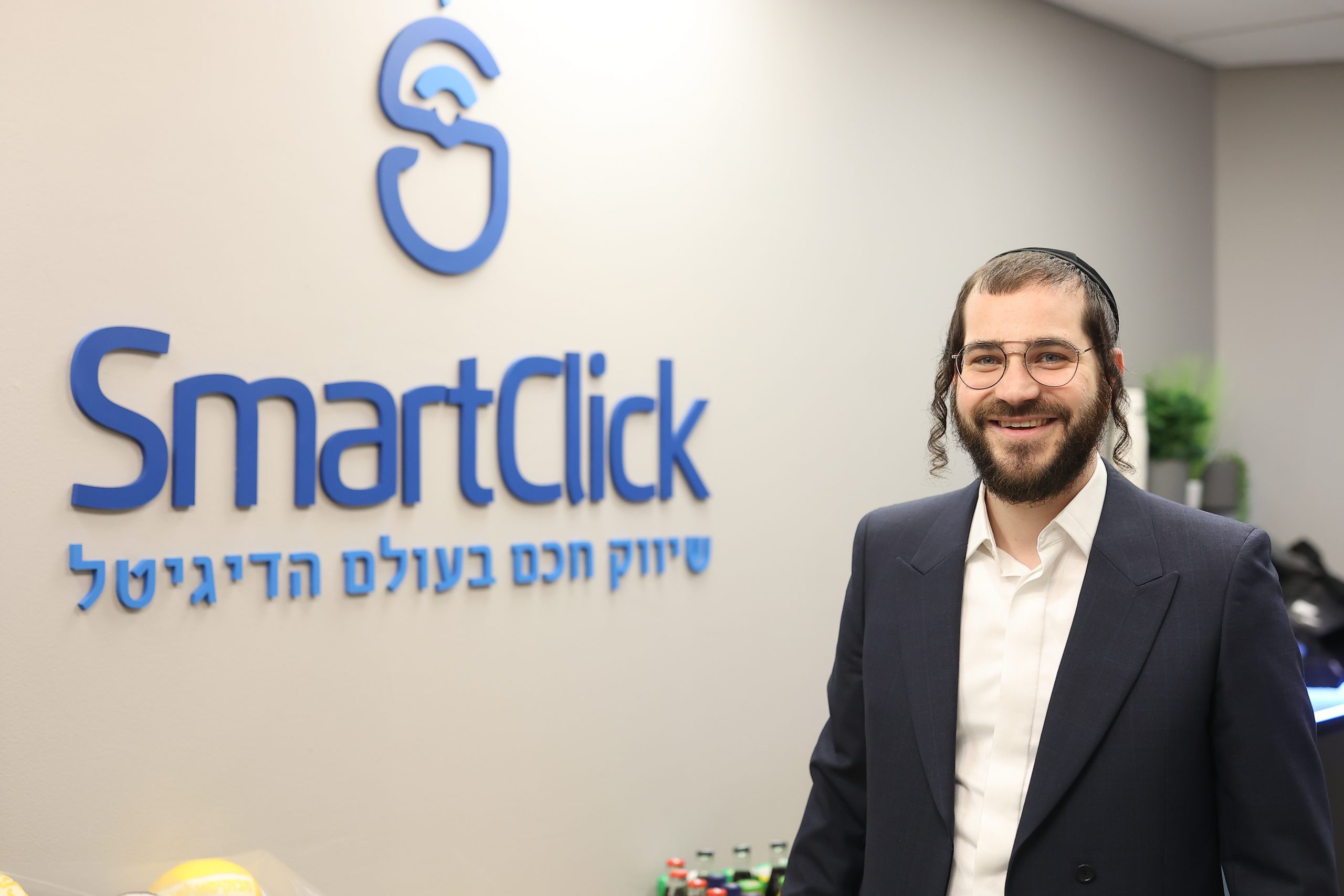
Moishe Levinger, owner and director of the digital advertising agency
'Smart Click'.
Why him?
The world of Haredi advertising is undergoing a significant process of transitioning between the offline and online worlds. Veteran advertising agencies are establishing digital departments in order to adapt to the changes. Moishe Levinger runs the first and largest digital advertising agency in the Haredi sector. His agency's specialization and expertise is primarily in the online world. The understanding that in order to create a correct and comprehensive campaign today, we must slice the advertising pie differently, and also bring a professional response to companies in the economy in the digital aspect - places digital advertising agencies at the forefront. In my opinion, the challenge today is the right combination, the right mix between offline - which still has a place of honor in Haredi advertising - and the understanding that alongside offline, online must also be given its place and professional attention. Moishe Levinger makes the right combination between the two.
•
Moshi Levinger, 33, a Belz Hasid, a resident of the city of Ashdod, married and father of three daughters. He studied and grew up in Belz institutions - in Haidar in Bnei Brak, where he grew up. He later studied in a small yeshiva in Bnei Brak, and then in a large yeshiva in Haifa. After his marriage, he studied in a kollel, and at the same time began to study marketing, completing his English and matriculation studies, advertising, and sales tactics. After his studies, he began working as a marketing person in a real estate project. "I studied at the Haredi branch of 'Habatzafar' - the leading and professional institution for training workers for the advertising and marketing industry in Israel - cycle number five. During the two years I was in the kollel, I began to study marketing. After that, I was a sales person for three years. Then I joined as a budget officer in an advertising firm and various offices.
Why did you apply to study in the field of marketing?
""When I was a salesperson, I understood what motivates me, and what interests me - that's people's motivation to buy. Why would I buy from you? The motivation really interested me. So I realized that it's the world of advertising. After Kollel, I just got to enter the world of advertising. "There's a wide world of marketing, one of the parameters of marketing - is sales. You understand that in order to create good sales, you have to start with marketing at the top. You have to create differentiation, public relations. "After being an advertising and public relations budgeter - I got to manage very large portfolios. I was at Paz-Gaz, Yafora Tavori, Sonol, Electra, I actually visited these factories - I realized that I loved it. "I got to know the large portfolios, how work is done in the haredi and religious sector. The meaning of managing a client portfolio is important, which accompanies me to this day. Doing digital requires being half high-tech, half advertising. You have to be both. Advertising - it's knowing how to manage the portfolio, knowing where you're holding, what makes the client happy, being involved in the client's sales process, being a partner in the sales funnel, and other things. Therefore, when you come from the world of advertising, everything is done very correctly. "Five years in large offices were my school. In the process, I realized that I love the new digital world. I was a client portfolio manager for five years, I learned sales from quite a few mentors. The digital world is smarter, hence the name 'Smart Click.' I opened the office together with Avrahami Kliger - the VP of the office, who has been managing the strategy and creative at the office with great skill ever since. I came to understand that the world of advertising and marketing was going to change - but I didn't realize how dramatic it was going to be. "For example, we did work for the 'Open University.' It couldn't advertise in newspapers, because academia didn't enter the Haredi press. But there are 100,000 people out there, let's talk to them digitally. Where are they in digital? We started with Haredi sites and from there 'Google'. "So I realized I needed to learn that. I went to learn digital campaigns. Comprehensive learning. Knowing how to analyze data, user data, where they are, how they behaved, how the advertising system affects users. "I turned my advertising arenas into something more technological - something more digital. Google, Facebook and Haredi sites. Over time, we developed and became an office 4 years ago. Today we are a company with special departments, everything is done digitally, we don't work with two media outlets but with 40 media outlets. "Even in the Haredi sector, during the Corona period, 100,000 Haredi joined digital. The thing is that we know how to reach kosher Haredi - a Haredi who only has an email or a kosher forum on his screen, we know how to reach him. We spread out across the entire network and prepare landing pages, let's say to study in a certain place." The firm's clients include Mayanei Hayeshua Medical Center, Pagi Bank, Osher Ad, Or HaChaim Books, Nativ Pituach, and the Rabbi Kook Institute. "We do more work for businesses that are medium-sized and larger," he says. [Gallery]
Moishe Levinger (Photo: Almog Hadash) and Chaim Kliger (Photo: Chava Laufer)
“"We can say that today there are over 350,000 ultra-Orthodox people online - that is, unique users who are online every day. You can sell to them, you can talk to them. They don't read newspapers today, they don't read magazines. Today there are 100,000 strictly kosher smartphones with a kosher stamp.".
You could say you're changing the rules of the game.
""Definitely, changing from offline to online. For example, Or Chaim Books - it has a branch called the Digital Branch. It runs a serious digital system. People want to buy online. It won't help to advertise in a newspaper, it needs to see your banners on Google, it needs an ad that will appear on Google.".
Do you operate these sites?
""Of course, operations, characterization, and online promotion - how to bring in surfers, how did surfers behave? Did the surfer purchase the book? Did they leave a 'lead' for Mayanei Hayeshua as a mother? Did they purchase an apartment in Beit Shemesh or not? We are connected to the 'lead' system - which is customer information. If you want to buy an apartment in Beit Shemesh, you fill in 'lead' on a landing page with the company name, and the salesperson gets back to you. Until two years ago, there were companies that only advertised in newspapers, they wouldn't advertise on 'WhatsApp', in 'Haredim 10', in 'Google' or Facebook. We know how to target the Haredim. "We made a revolution. Businesses that weren't connected to digital and want to speak to hundreds of thousands of Haredim who are digital - and are abandoning the print press. Men consume less in magazines, the difference between offline and online - that offline is going to waste. In online worlds, you can 'colorize' the customer and chase them with advertisements. You can get him to sign up, become a member of a club - you can do a lot more things with him. The potential of a surfer compared to a newspaper reader is a much broader potential. In newspaper advertising, the reader picks up the phone and that's where the involvement with him ends. "We have a strategy and creative department, and a special media department, and a customer portfolio management department - whose job is to make sure the customer is satisfied. They get up every morning and ask the customer - we literally see how many 'leads' he got in yesterday, how many sales he had yesterday - we have a conversation with him, how are you? How did it go for you? We see what's going on in his business and where we need improvement. And we suggest: Let's do this and that, here we did well, here less so. "For example, if a lot of 'leads' came from such media, let's add a budget here. Everything is handled differently. "In the general sector, budgets are moving to digital, to online, much more than in the Haredi sector. In the Haredi sector, there are those who are preserving the print, claiming that there are not many Haredi in digital - which is of course not true. There are many Haredi. We need to put a budget in print, but give due respect to digital. The budget currently does not match what is really happening.".
What do you think will happen in the world of advertising and marketing in a few years?
""It's going more and more that way... In 10 years we'll be 50-50 compared to today, which is around 10-15 percent of the budget for digital. Very little. Because they don't know how to do digital. "I'm a pioneering advertiser, who does digital work properly. On the one hand, I understand advertising, on the other hand, I understand high-tech, I understand technology and digital. "By our firm's definition, it only does digital. We also know how to deal with the print press and there are clients who are interested in that - and we know how to do excellent strategy and creative. But we are ten steps ahead in the digital world. "Today we are already receiving calls from large businesses who want to understand what digital is, how to do it right.".
Haim Kliger chose you as the 'next big thing' in the world of marketing.
""Haim is one of the most senior and veteran advertising people there is. He agreed to see the potential in digital. He established an excellent digital platform, he understood that this is going to the digital world. I am happy and proud that he chose me. He was able to bring achievements in election campaigns and also in business systems and brand implementation.".
In the world of music: Yohanan Bleich, arranger and music producer, 26 years old from Betar
In the world of Haredi radio: Ari Hamnik, presenter and broadcaster, 32 years old from Beit Shemesh
 Join the Haredim 10 Facebook page >>
 Join the X page of Haredim 10 >>
 Want more news, videos and stories? Join the Haredim 10 WhatsApp channel >>