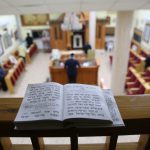
When the wealthy neighbor stopped me on the street corner near the square across from the synagogues and informed me that he wanted to tell me something, I knew that no good would come of this conversation.
The young man, a former 'high school student', liked to influence others with the light that shone on him, and so I was not surprised when he said that for seven months he had been wanting to tell me something, and he believed that now 'the time had come.'.
Well what?
'"Do you remember," he asked, "that I held a male peace event ['Sholam Zoker'] for Bni Elhanan, who was born seven months ago?"
I didn't remember, but I kept my thoughts to myself, of course. I believed that he had a son, and it only made sense that he held the familiar Ashkenazi event for him.
I waited for the continuation.
'"You were at that event," he said, and this time I nodded enthusiastically, obviously I was.
So what's the problem, I asked.
'"I won't comment on the fact that you came to me, on a Saturday night, without a hat and a suit," he said. "That's fine, but what happened next was serious.".
'What was it?' he asked rhetorically and answered himself: 'There sat a rabbi from the neighborhood, a kind of 'maggid,' you remember, and he repeated with his familiar enthusiasm that after a Jew has prayed Mincha once in public, with devotion despite the obstacles and motivations that stood in his way at that time, then all his other prayers from then on are counted to him as if he had prayed them with the same devotion.'.
And then? I asked tensely because I was already into the story.
''Then, you said: What's the connection? He deserves a reward for that one time. Why should the rest of his prayers also be considered prayers of devotion?'
It sounded logical. A question of this kind fits my way of thinking, but I didn't have time to ponder it for long, because the avrach now said with suppressed anger: 'What was your urgency to darken the atmosphere, to suddenly shatter the feeling of elation that everyone had? The rabbi gave encouragement to the avrachim around the table, and then the question of your 'heresy' appeared and, as it were, brought us back to this world.'.
•
This true story, which has no end, because I really had nothing to answer the man who had kept his anger inside for months, gave me an interesting insight.
Various currents make up this vast group called "ultra-Orthodox society," but the differences between them are not limited to overt and covert behavior, thinking patterns, and coping with the challenges of 21st-century reality and civilization, but also to the aftermath that that behavior leaves in the public sphere.
If a question (which was probably asked by me in a 'like-automatic' manner not only angered my interlocutor, but also convinced him that the neighbor who appeared on 'Shulam Zochor' wearing a colorful sweater was trying to ruin the uplifting atmosphere he had achieved at his private event, I am forced to think that he might be right.
Perhaps there was a built-in, almost subconscious experience here - the beatus in sociological language - that prompted me to raise this question, at this particular time and in this particular tone.
Perhaps I was trying, unwittingly, to break down the religious atmosphere that prevailed there, since it was bothering me.
And if so, is he right in his argument? Was I 'wrong'? Isn't it appropriate for a 'Rambamist' Jew, for that matter, to express an opinion at a Hasidic gathering, when his arguments are definitely not in line with the prevailing atmosphere there?
And what does all of this have to do with the religious wars of the 'haters' and 'terrorists' over the public-ultra-Orthodox atmosphere in the State of Israel?
 Join the Haredim 10 Facebook page >>
 Join the X page of Haredim 10 >>
 Want more news, videos and stories? Join the Haredim 10 WhatsApp channel >>