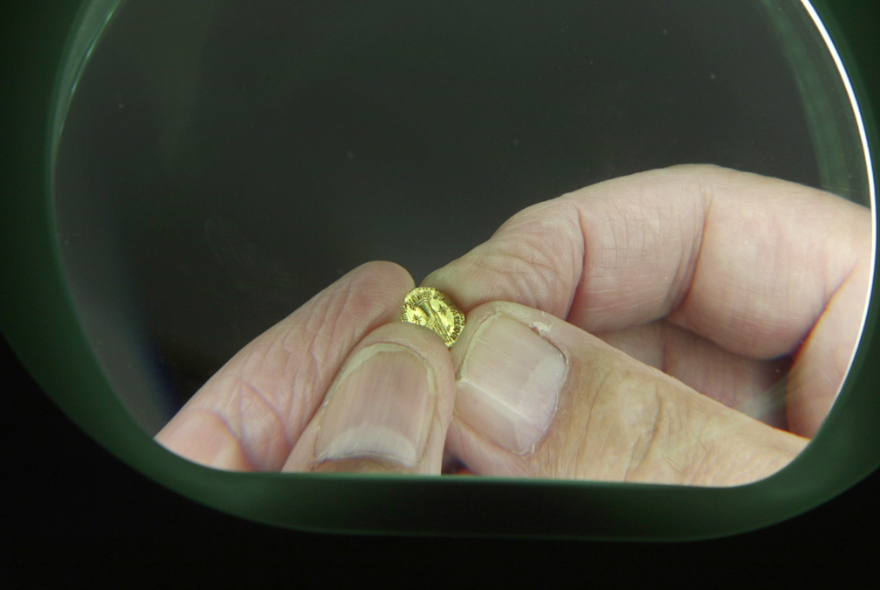
A very rare gold coin, bearing the portrait of the Egyptian Queen Berenice II, was discovered in an archaeological excavation by the Israel Antiquities Authority in the City of David in the National Park surrounding the Walls of Jerusalem.
This is a small coin of a quarter drachma value, made of pure gold (99.3%), dating from 246–412 BC - during the reign of Ptolemy III, the husband of Queen Berenice II.
This is the first coin of its kind in the world to be found in a clear archaeological context, and one of only 20 known in the world.
The rare coin will be presented to the general public at an exhibition that will take place in early September as part of the City of David Research Conference.
The obverse of the coin depicts a portrait of Berenice as a Hellenistic queen, with a tiara and veil on her head, and a necklace around her neck. The reverse of the coin depicts a cornucopia, a symbol of success and fertility, with stars on either side. Around the cornucopia appears the inscription “Of Queen Berenice” in Greek.
The coin was discovered while sifting through buckets of dirt next to the excavation site by Rebecca Langler, an excavator at the Givati parking lot. "I was sifting through the dirt from the excavation and suddenly I saw something shiny. I picked it up and saw that it was a gold coin. At first I couldn't believe what I was seeing, but within seconds I started running around the entire excavation with excitement. I've been digging in the City of David for two years now and this is the first time I've found gold! There have always been diggers who have discovered all kinds of special finds and I've always been waiting for it to be me - and now it's my time!""
""The coin is the only one of its kind discovered outside of Egypt, which was the center of Ptolemaic rule," say Dr. Robert Cole, head of the coinage branch at the Israel Antiquities Authority, and Dr. Chaim Gitler, chief curator of the Archaeology and Numismatics Department at the Israel Museum, who studied the coin.
The Greek inscription “ΒΑΣΙΛΙΣΣΗΣ” – "of the queen", is rare on coins from the period. "Queen Berenice appears here not as a consort to the king, but perhaps as a ruler in her own right. Women appeared intermittently on coins of the Ptolemaic dynasty for almost 300 years (305 to 30 BC), the most famous of which was Cleopatra. However, this is one of the first cases in which a Ptolemaic queen appears on a coin with this title during her lifetime – indicating exceptional independence and political power.
""The coin was probably minted in Alexandria, Egypt, perhaps to serve as a grant to Egyptian soldiers who fought in the Third Syrian War, in the struggle that took place between the Ptolemaic Kingdom and the Seleucid Kingdom in Syria.".
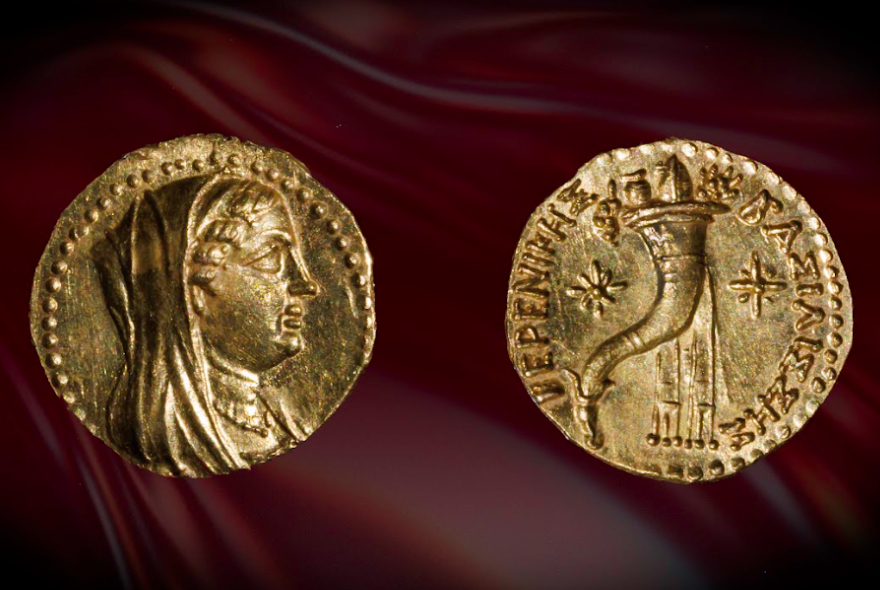
Dr. Cole and Dr. Gittler emphasize that "about 20 such coins are known worldwide, and this is the first of its kind ever discovered in an organized archaeological excavation, which makes this coin of exceptional research value.".
The excavation directors, Dr. Yiftach Shalev of the Israel Antiquities Authority and Efrat Botzer of the Jerusalem Research Center: "The fact that such a rare gold coin was discovered in Jerusalem during the period when the Ptolemaic rulers of Egypt ruled the country provides a fascinating glimpse into the status of the city during those years and into the possible relations that the government in Jerusalem had with the center of power of the empire, which controlled the area from Egypt.".
""The coin discovered in the City of David carries with it broad significance regarding the development of the city of Jerusalem after the destruction of the First Temple. Until now, the prevailing image in research has been that Jerusalem after 586 BCE was a small, marginal city with few resources. The coin – and alongside it a set of additional finds from the mid-3rd century BCE – sheds a different light on the city: Jerusalem, it seems, began to recover as early as the Persian period and became even stronger in the Ptolemaic period.".
""Jerusalem in the centuries following the destruction of the First Temple was not desolate and isolated – but a city in the process of reconstruction, reconnecting with the ruling centers of power, economy and culture of the period.".
The coin and other gold jewelry found in the Givati parking lot excavation will be presented to the public as part of the 26th City of David Research Conference, which will be held in early September.
 Join the Haredim 10 Facebook page >>
 Join the X page of Haredim 10 >>
 Want more news, videos and stories? Join the Haredim 10 WhatsApp channel >>